About
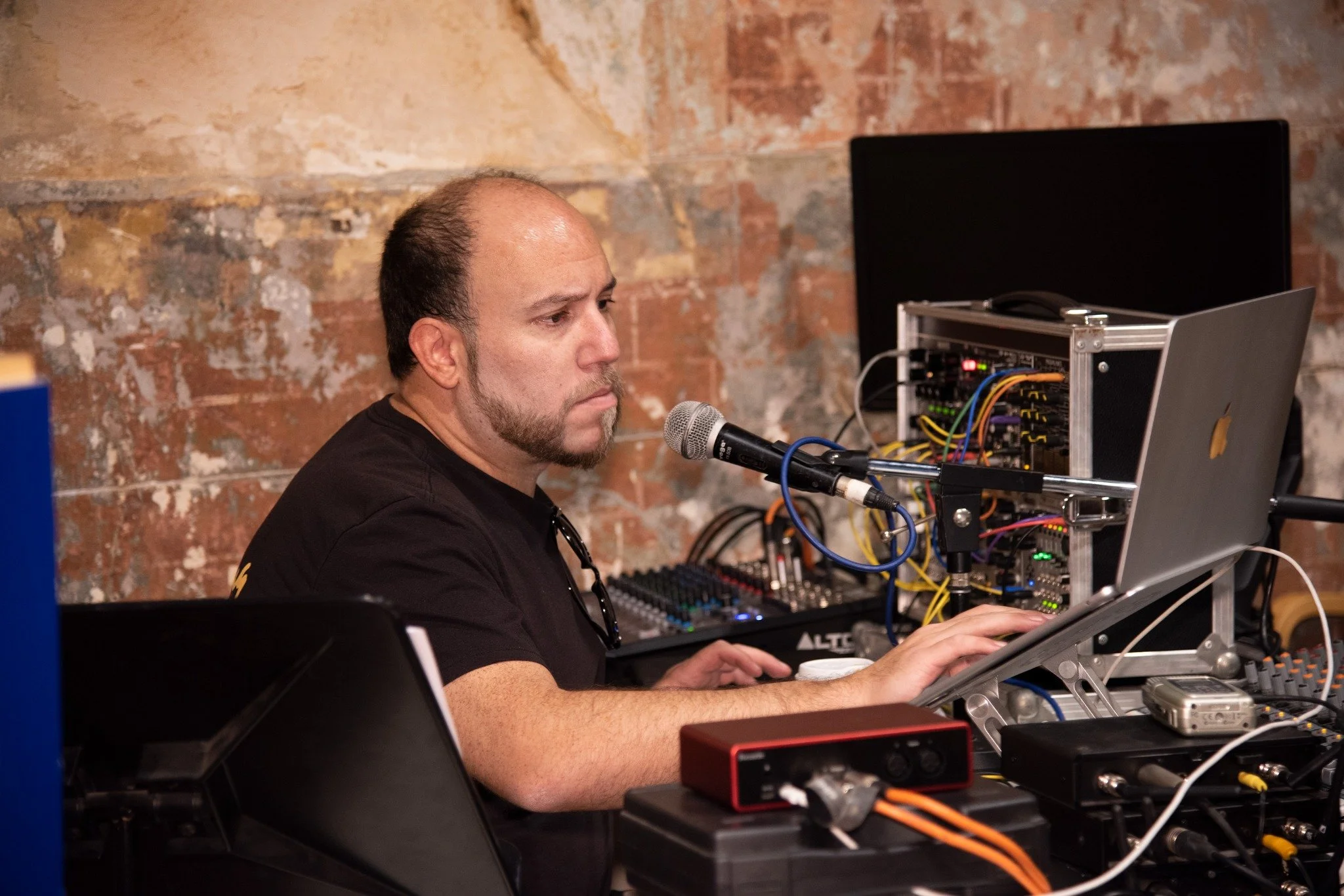
Mark Oliveiro is an Australian composer-researcher, interactive media artist and technologist. His work connects instrumental and electroacoustic composition with live electronics, audiovisual performance and participatory music. Composition is the organising practice across these activities: he develops scores, electronic instruments, software, interfaces and performance situations through which musical expression can emerge in interaction. His work asks how agency is shared among composers, performers, audiences and technologies, and how sound, image, timbre and gesture shape the experience and ritual of performance.
Born in Sydney, Oliveiro began composing at fourteen through MIDI and computer music. He studied at the Sydney Conservatorium of Music, graduating with first-class honours, and continued postgraduate study in computer music at Indiana University, where he was composer in residence at the Wells-Metz Theatre. He completed a PhD in Music at the University of North Texas in 2016. His dissertation, Compositional Approaches within New Media Paradigms, accompanied the new media chamber opera BoMoH and examined ways of composing through interactivity and multimedia design. Research and creative practice remain closely connected in his work: making a piece can also mean developing an instrument, designing an interface or testing a relationship between media.
Oliveiro’s catalogue spans orchestral, chamber and vocal music, fixed media, and music for theatre and dance. Early commissions include Order of Chaos for Orchestra Victoria and Bushfire Sun, presented by BIT20 at Italy’s Stresa Festival. Daina was written for the Latvian ensemble Altera Veritas. Cyan Echo II combines solo cello, string orchestra and electronics, while PRISM introduced a gestural controller into an orchestral and electronic setting. Through the Australian Music Centre and Song Company’s MODART programme, he developed DOA, a vocal work combining electronics and Malay Creole text. The song cycle IL GARROT brings together Il Violon, A House Divided and Colloque sentimental. These works show a long-running interest in how instrumental practice and inherited musical forms meet new performance conditions.
Collaboration with performers has generated a varied electroacoustic repertoire. TANoX, for alto saxophone, harp and fixed media, is among Oliveiro’s most widely performed works internationally. Its interpreters include Pictures on Silence, Kyle Hutchins with Ann McLaughlin, and Trefon Gmyrek DUO; an American Composers Forum Encore Grant supported Pictures on Silence’s performances across the eastern United States. In Maluga received fifth prize in the Australasian division of the 2010 Jeu de temps / Times Play competition and was selected for the Cache 2010 compilation. Written for recorder player Alicia Crossley, Calliphora has been performed internationally and featured in her May 2026 Brisbane Music Festival programme. The work received second prize in the 2013 ASCAP/SEAMUS Student Commission Competition. In 2016, an inaugural Art Music Fund commission supported Oliveiro’s later work Tolak Balah. His other instrumental works include Sikinnis, which received the 2013 ICMC Student Prize; Black(midi)matter for tenor saxophone, computer sound and visuals; and String Theory, developed with recorder player Alana Blackburn for Paetzold contrabass recorder, electronics and projections. Motherboard, performed by Decibel in 2017, places circuit-bent toys within a concerto setting.
Oliveiro’s broader score archive includes works for orchestra, chamber ensembles, voice, piano, saxophone and electronics, alongside fixed-media and audiovisual pieces. Lo-fi Déjà vu, first composed in 2019 and revised in 2024, explores an intimate lo-fi sound world. The three-movement Viaji di Som includes the piano work Ung Marynieros. DEEPFAKE is scored for alto saxophone and brass synth. These scores sit alongside the performance systems and electronic works that inform his practice as a composer, performer and technologist.
Recent concert projects continue this exchange between instrumental craft and electronic invention. Electronic Suite, for piano quartet and generative electronics, premiered in December 2025 at The Church, Alexandria, as part of Phoenix Central Park’s Ambient Delights programme. On 30 May 2026, Oliveiro was composer, technical lead and electronics performer for Ports: from Kowloon to Kamay, curated and directed by pianist Jocelyn Ho. His composition, Viaji di Som, brings Branyo rhythms into a multimedia exploration of migration, memory and belonging. The collaborative work places Oliveiro’s live electronics alongside Ho’s piano, Nicholas Ng’s Chinese instruments, Si Yi Shen’s projections, and poetry by Eric Yip and Crispin Rodrigues. His piano and electronics work Upside / Downwater received its world premiere with pianist Brieley Cutting at Master Music Studio in Glebe on 23 August 2026.
Oliveiro’s audiovisual work includes Cyborg Salon, premiered with Brieley Cutting and Judit Molnár within Electro Lieder at Sydney Fringe Festival in 2023, and Deepfake for Sax, presented at the Australian Institute of Music’s 2024 symposium. With saxophonist Andrew Smith, Black Summer, Black MIDI formed an extended audiovisual programme at the 2020 Australasian Computer Music Conference. His practice as a DJ, synthesist and VJ informs his approach to timing, gesture, improvisation and the relation between musical structure and visual presentation. His technical work encompasses Max/MSP and Jitter, modular and analogue synthesis, sound design, live processing and audiovisual production, as well as the practical systems of sound reinforcement, recording, projection and signal routing that make performances possible.
His research examines these activities from within creative practice. At the 2023 Australasian Computer Music Conference, he presented an autoethnographic study of VJ performance, drawing on work in Sydney’s electronic music clubs. He co-chaired the 2024 conference and presented research on remix theory in the music of Doom, alongside a co-authored presentation on AI in music education. At the 2026 NowNet Arts Conference, he presented a performance demonstration exploring constrained transmission as a telematic performance environment. Related projects include Hexa-Loop, which invites remote audiences to influence musical activity, and continuing enquiries into musical agency, recomposition and performance ritual. Through Incredimod and related interactive composition tools, he also develops playful ways for learners to listen, arrange and recompose music.
Oliveiro has presented work at the International Computer Music Conference, SEAMUS, Electronic Music Midwest, the World Saxophone Congress, the Australasian Computer Music Conference and Vivid Music. He has received the British Trombone Society’s 2012 unaccompanied composition prize for Tartarian Psalm II, Indiana University Dean’s Prizes in Electronic Music in 2008 and 2010, and a Dame Joan Sutherland Travelling Scholarship in 2009. In 2016, an inaugural Art Music Fund commission supported Tolak Balah.
Oliveiro is Program Lead, Graduate Studies at the Australian Institute of Music, where he teaches and supervises composition, research and creative practice. His recent work includes presenting interactive composition tools at the 2026 FOBISIA Music Teachers Conference in Singapore, leading a mixing and songwriting masterclass at SOMA, and serving on the judging panel for the inaugural Sydney International Music Competition. He is President of the Australasian Computer Music Association and an Associate Artist of the Australian Music Centre.